Showing posts with label canadian real estate. Show all posts

Monday, January 17, 2011

Release: Department of Finance tightens CMHC rules

TD Economics


  • For the second time in twelve months, the Department of Finance tightened rules on residential mortgages to help slow the pace of household debt accumulation. Changes include shortening the amortization period to 30 years (which had already been shortened from 40 to 35 years in 2008), withdrawing CMHC insurance of home equity lines of credit (HELOC), and a reduction in the maximum refinance percentage from 90% loan-to-value to 85%. Changes to the amortization period and the refinancing ratio will take effect March 18 and the HELOC change will take effect April 18, 2011.
lawlessbrown.com

Friday, July 23, 2010

Bank of Canada interest rate unlikely to top 1% this year


John Shmuel July 23, 2010 – 11:16 am

Slower than expected economic growth in the U.S. is set to hamper Canadian exports, meaning the Bank of Canada’s interest rate is unlikely to rise beyond 1% by the end of the year, says a research note from Lombard Street Research.

The bank raised interest rates by 25 basis points earlier this week to 0.75%, in a move that was widely expected. The note, authored by analyst Michael Taylor, points out that the bank adopted a very cautious stance in regard to the Canadian economy going forward.

But Lombard Street Research said it expects lower growth than even the Bank of Canada’s revised figures. That leads Taylor to suggest that interest rate hikes from the bank are likely going to be hold on for much of next year.

"We would agree with a domestic slowdown, due to the expiry of temporary policy measures as well as the effects of higher interest rates on a highly indebted household sector. But the Bank has a rather optimistic view on US real GDP growth, which is expected to be around 3% both this year and next. Healthy growth in the US, combined with the recent fall in the Canadian dollar, has resulted in an increase in projected export growth for 2010 and 2011. Our view is that US growth will be below-trend over the next 18 months or so, restricting the scope for Canadian exports to grow strongly (three quarters of which go to the US)."

That leads Taylor to conclude that although a rate rise is likely at the next bank of Canada monetary policy meeting in September, he expects rates to be on hold thereafter for quite some time.

Read more: http://business.financialpost.com/2010/07/23/bank-of-canada-interest-rate-unlikely-to-top-1-this-year-report/?utm_source=twitterfeed&utm_medium=twitter#ixzz0uWj05DPa


lawlessbrown.com

Tuesday, June 15, 2010

Managing debt while rates grow


Terry McBride , For Canwest News Service SASKATOON -- Canadians have taken advantage of extremely low interest rates to overextend themselves. The Bank of Canada wants to try to prevent inflation by raising interest rates to slow the economy down. How will debtors manage?

Inflation vs. deflation

Actually, debtors generally prefer inflation (when prices go up) because that can make it easier to repay a debt, which is a fixed dollar amount owing. Loan payments become more affordable when wages keep up with inflation.

Debtors usually fear deflation (when prices go down) because it becomes more difficult to repay an obligation when the fixed number of dollars can buy more. Deflation is already a major concern these days in Europe where some governments are raising taxes and cutting back on spending to tackle mushrooming public debts. Businesses there may be forced to cut prices and workers’ wages to cope with the economic slowdown.

Debtors fear deflation. How can they handle debt payments after their wages are cut or they lose their jobs? Serious household debt management issues arise.

Mortgage term

If your mortgage is coming up for renewal, how do you choose the best mortgage term? If you have had a variable or floating rate of interest tied to the prime rate, should you take the safe route and lock in a fixed, usually considerably higher, interest rate for five years?

If your mortgage payments rise, then you will have to look at various ways to manage other debts.

Consolidate

One popular debt management strategy is to combine various loans into your mortgage or a line of credit. Consolidation can eliminate high-interest credit card debt. Free up some cash flow by reducing your interest costs.

Talk to a professional debt counsellor. Can you have a single monthly payment? You could continue to make the same level of payments on your consolidated loan as you did before consolidation. Aim to reduce your principal owing and cut interest costs.

Amortization

Knowing how amortization works will help you to understand how to properly manage your debts. Amortization is how long you are scheduled to repay an instalment loan.

If interest rates rise, consider stretching the repayment period on an instalment loan to reduce the size of your monthly payments. Making your payments smaller seems very attractive at first. However, by making payments over a longer time period you will eventually pay much more interest in the long run.

Debt snowball

Here is a strategy for cutting down your overall debt level:

Make a list of your debts. Add up how much you pay on each loan.

Pick the smallest debt to tackle first. Pay the minimum on all debts except for your target debt. Pay whatever is left on your target debt until it is paid off. Then, continue with the debt snowball strategy by choosing the next debt on the list as your target debt. Pay it off.

Borrow wisely

The next time you have to borrow, avoid buying something that drops in value. The only time you should buy something using debt is if it is something that will appreciate in value or generate additional cash flow for you.

As a general rule, if you are buying something with borrowed money, make sure that what you buy lasts longer than the debt. Don’t add to your debt burden by going on a vacation financed by credit cards.

Emergency fund

Do you have to borrow when you have an emergency? Instead you should build an emergency fund with cash held in reserve. You could use a Tax-Free Savings Account, the cash surrender value of a whole life policy or a Canada Savings Bond payroll savings plan, for example. Having cash available to pay for an emergency will give you greater financial security than an untapped line of credit.

Terry McBride is a member of Advocis (The Financial Advisors Association of Canada)

lawlessbrown.com

Wednesday, May 26, 2010

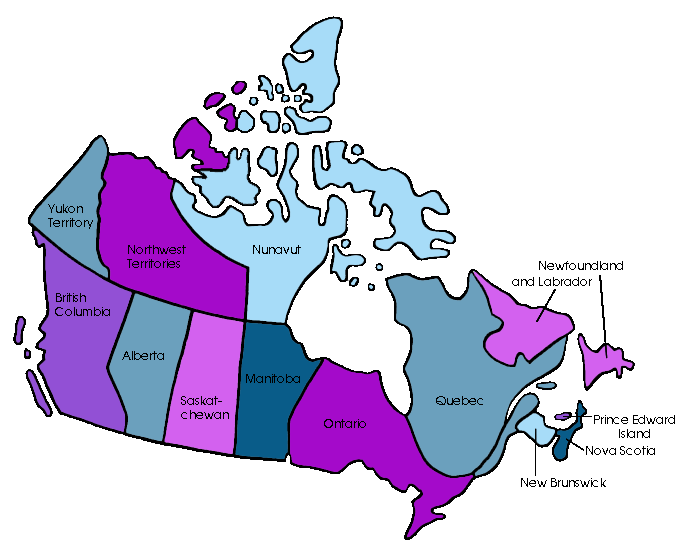
Highlights from across Canada:


- British Columbia: Homeownership became even more expensive in B.C.,

as strong home price momentum continued in the first quarter. Housing

affordability measures have now returned close to the all-time highs

reached in early-2008. This trend represents a risk that could weigh

heavily on the province's housing market in the near term.


- Alberta: Affordability measures eased in the first quarter, as

Alberta was the only province to show a decline in the costs

associated with owning a home. Housing price increases in the

province were fairly modest over the past year, which has kept home

ownership relatively affordable. RBC affordability measures are at or

below the long-term averages.


- Saskatchewan: Housing prices picked up in the province in early 2010,

causing home affordability measures to rise significantly in the

first quarter. This is a change from previous quarters, which showed

an improvement in affordability. Despite this increase, affordability

measures still remain well below the all-time peak levels reached in

early-2008.


- Manitoba: Prices for most housing types surged ahead in the first

quarter of 2010, pushing affordability measures above the long-term

average for the province despite a slower pace of resale activity.

Affordability in the province has reached a point where an additional

decline in home affordability may temper housing demand.


- Quebec: Quebec's housing market rally continued in the first quarter

of the year, with record-levels of buying activity and rising

property values. This escalation in home prices, while more moderate

than in the previous two quarters, weakened affordability in the

province. All affordability measures now exceed their long-term

average, which may soon slow housing demand in the province.


- Atlantic Canada: Resale activity on the East Coast remained solid,

with an increase in sales met by a rise in the supply of available

homes. These broadly balanced conditions have limited the pace of

price increases in the region. Overall housing affordability in

Atlantic Canada continues to be among the most attractive in the

country, with measures still below long-term averages.


The full RBC Housing Affordability report is available online, at www.rbc.com/economics/market/pdf/house.pdf

lawlessbrown.com

Monday, May 17, 2010

Fixed or float?


Combination mortgages increasing in popularity: RBC poll

TORONTO, May 17 /CNW/ - The popularity of combination mortgages - which offer both fixed and floating rate segments - is on the rise, according to RBC's 17th Annual Homeowners Survey. In fact, 40 per cent of Canadians who are likely to purchase a home within the next two years plan to take out a combination mortgage, compared to 32 per cent in 2009.

The surging popularity of combination mortgages indicates that Canadians are trying to maximize low interest rates while at the same time retaining the security of a fixed mortgage. The poll also revealed a marked gender split with more women (46 per cent) than men (35 per cent) preferring a combination mortgage.

"Although interest rates are expected to rise, our study shows that not all Canadians intend to automatically opt for a fixed mortgage with a longer term," said Marcia Moffat, head, Home Equity Financing, RBC Royal Bank. "As consumers begin to learn about the benefits of mortgage diversification, we're seeing more homebuyers gain a better comfort level with adding floating rate mortgage options."

While combination mortgages are gaining in popularity, fixed-rate mortgages continue to be the most common choice for potential buyers and are preferred by 44 per cent of Canadians likely to buy a home within the next two years. Atlantic Canadians are most likely (54 per cent) to opt for a fixed rate, with Ontarians (41 per cent) least likely to do so.

"Many Canadians believe that a fixed-rate mortgage is the only way to have a locked-in and predictable payment, but a variable rate does not always mean variable payments," noted Moffat. "With our floating-rate mortgage, the portion of your payment that's applied to the principal changes, as interest rates change, not the actual payment itself. This means that when interest rates go up, your payment will pay off more interest; when interest rates go down, your payment will pay off more principal."

When current homeowners were asked about the impact of potential interest rate increases, 66 per cent said they were concerned, with women (70 per cent) more concerned than men (60 per cent).

"We expect the Bank of Canada to increase the overnight rate starting in June, with the pace of increases being fairly steady through the remainder of 2010 and 2011, which will continue to put upward pressure on borrowing costs," added Paul Ferley, assistant chief economist, RBC Economics.


Mortgage findings at-a-glance:

Fixed rate mortgages are preferred by:

- 44 per cent of Canadians likely to buy a home within the next two
years - down from 47 per cent in 2009

- 54 per cent of Atlantic Canadians (the highest in Canada)

Variable rate mortgages are preferred by:

- 16 per cent of Canadians likely to buy a home within the next two
years - down from 20 per cent in 2009

- 19 per cent of men compared with 12 per cent of women

Mortgage term most likely to be chosen by those opting for a fixed or
combination mortgage:

- Five-year term: 43 per cent

- More than five-year term: 29 per cent

- Three-year term: eight per cent

63 per cent: the proportion of Canadian homeowners who have mortgages
(compared to 56 per cent in 2005)

$124,131: the average amount remaining on Canadian homeowners' mortgages
(compared to $109,504 in 2005)

Lawlessbrown.com

Wednesday, January 27, 2010

Canada Mortgage Bonds 101


Enhance financing that reduces mortgage financing costs for Canadian homebuyers

Canada Mortgage Bonds (CMBs) are debt securities fully backed by CMHC, that provide investors with a return that’s better than government bonds. CMBs are important to the Canadian housing market, because they provide vital liquidity to keep the housing market moving.

The amount of debt outstanding under the CMB program has increased by 20% over the last year (mid-August 2009) to $168 billion and attracted international investor support, which suggests continuing investor confidence in the Canadian residential real estate market.

Here’s how the process works:

1. Lenders originate mortgages
2. Lenders aggregate a group mortgages (also known as pools) for the purpose of selling them to investors
3. Lenders sell these pools as mortgage-backed securities (MBS) to the Canadian Housing Trust (CHT), a CMHC-run entity
4. The CHT sells Canada Mortgage Bonds (CMBs) to generate funds to buy the lenders' mortgages
5. The CHT uses the MBS cash flows to make interest payments on these CMBs to investors.
6. The lenders take their proceeds and re-circulate them again as new mortgages

Because CMBs are fully guaranteed by the government, investors demand less interest on CMBs. That lowers the cost of funds for lenders and thereby lowers the cost of mortgage financing in Canada.

Courtesy of First National Financial

lawlessbrown.com

Monday, January 11, 2010

Make Sure you can afford your Dream Home


January 11, 2010
By Jim Adair

For first-time buyers in particular, it s a confusing time. Canada is just coming out of a tough recession that cost a lot of jobs and hurt consumer confidence. Everyone is aware of the troubled real estate market in the U.S. But since the spring, Canada s resale housing market has been booming, thanks to rock-bottom mortgage interest rates. So is now the time to buy and take advantage of the low rates?

While today s ultra-low borrowing costs represent a unique opportunity to purchase a property, home buyers need to proceed with caution and keep in mind that renewal rates will likely be substantially higher in coming years, says Sal Guatieri, senior economist with BMO Capital Markets.

Jan Yuen, a senior manager at BMO Capital Markets, adds: Stretching the limits of your budget by choosing the maximum amortization period and a minimum downpayment leaves you little wiggle room to deal with an unexpected financial challenge. A meaningful downpayment and shortening your amortization by making extra payments on your mortgage will save you tens of thousands of dollars in interest costs.

For example, Benjamin Tal of CIBC World Markets says that on a $250,000 mortgage with a five per cent rate amortized over 30 years, adding a full month of extra payments each year works out to a de facto shortening of the mortgage amortization period by five years. If interest rates have gone up, translating years into basis points means that by simply switching from an accelerated payment plan to a regular one means borrowers would be able to absorb the first 75 basic points on a rate increase, says Tal.

BMO advises borrowers to do a stress test on their budget to see if they can afford rate increases. For example, customers looking to renew a $250,000 mortgage currently priced at 2.25 per cent would see their monthly payment to increase by $260 a month if rates were to increase by two percentage points, says BMO.

BMO also suggests that mortgage holders make weekly or bi-weekly mortgage payments if possible. They should also take a close look at fixed versus variable-rate mortgages. While variable-rate mortgages have been a winning strategy over the long term, fixed-rate mortgages (currently at historic lows) come with the peace of mind of being insulated against rate increases and knowing how much of your mortgage you will have paid down at the end of your term.

It says total household costs, including mortgage payments, property taxes, heating and utilities, should not be more than one-third of household income.

The Bank of Canada says that 5.9 per cent of Canadian households are vulnerable to rising interest rates because their debt-service ratio is more than 40 per cent. It says that if rates rise by 300 basis points by 2012, that percentage of vulnerable households would rise to 8.5 per cent.

But in a recent report, Tal says that focusing on a borrower s debt-service ratio with no reference to the underlying asset (the equity in the house) can be misleading. He says when equity is added to the equation, the number of households that would be vulnerable to a rate shock is less than four per cent.

Another potential buffer to rate shock, says Tal, is the fact that most Canadian financial institutions limit their variable-rate customers to a mortgage that they would qualify for at today s three-year fixed-term rate, well above current variable rates. While all borrowers will face the impact of higher rates, most of them will therefore be able to absorb a 300 basis point rate hike and still remain within the qualification threshold.

Tal adds: Also note that in general, low-income Canadians tend to rely more heavily on fixed-rate mortgages -- the complete opposite of the situation south of the border where low-income Americans were heavy users of variable-rate mortgages. While even fixed-term mortgages will eventually be reset, the longer time frame for any hikes in their borrowing rates leaves them with more time to pay down principal and benefit from rising incomes before that hits.

Many analysts believe the housing market will slow down during the coming year, and that house prices will not appreciate as rapidly as in 2009. In the housing industry, everyone from the Mortgage Brokers Association of British Columbia to the president of the Building Industry and Land Development Association of Toronto is urging Flaherty to let the market settle down on its own before taking regulatory steps.

lawlessbrown.com